
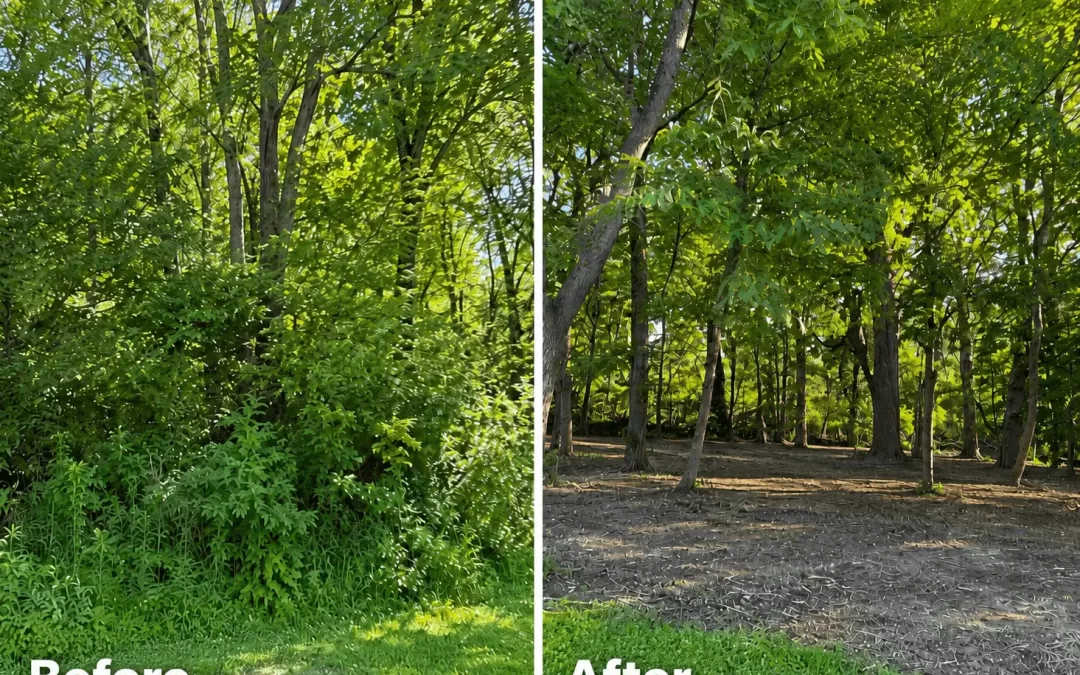
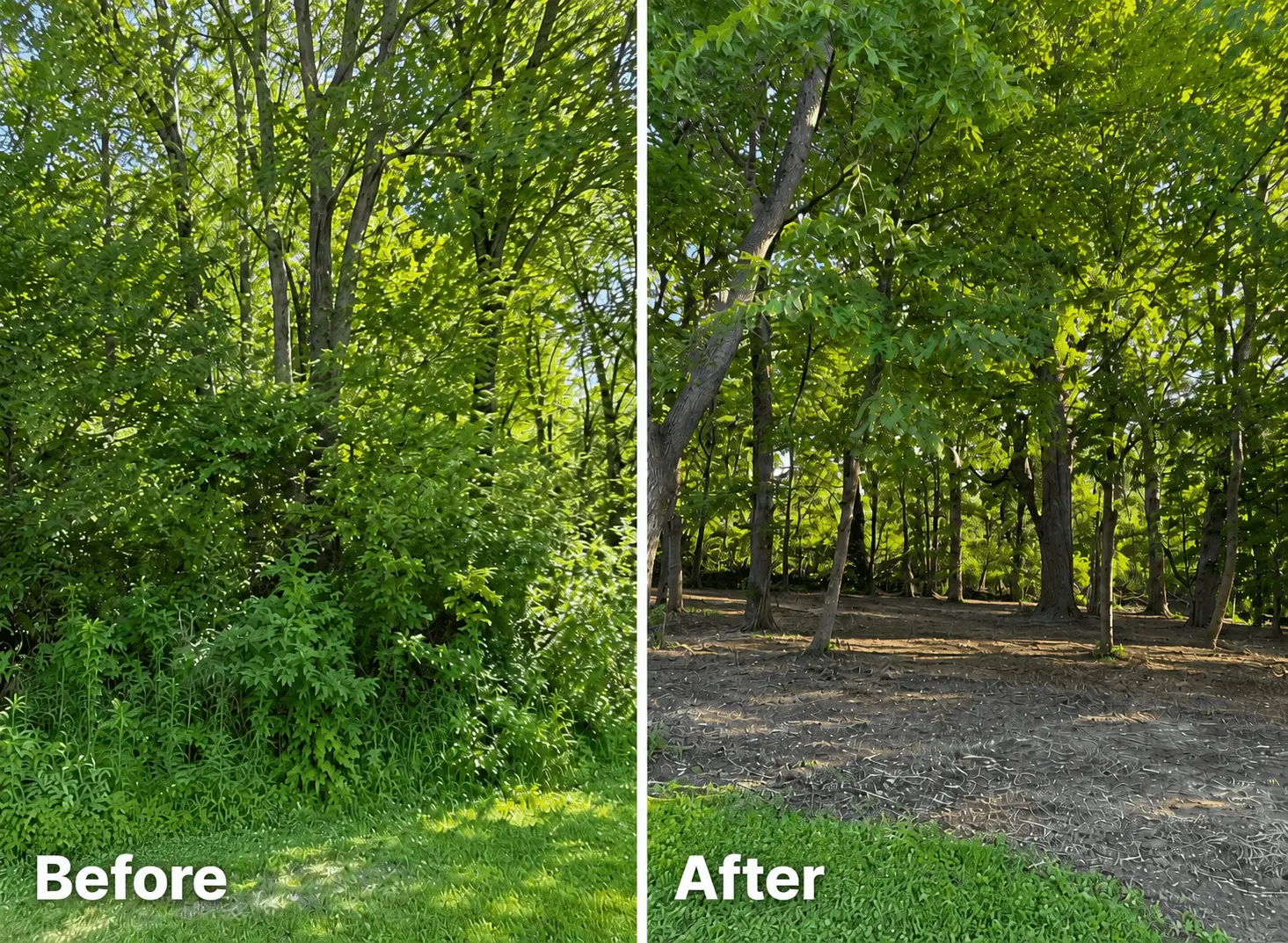
Professional buckthorn removal for wooded lots, fence lines, acreage, and overgrown residential properties across the Chicago suburbs. GrindForce uses high-flow forestry mulching equipment to clear dense buckthorn and invasive woody brush in place. Designated keeper trees remain, processed material stays on the property as a ground-level mulch layer, and the cleared area is left open for its next use.
Forestry mulching is the right starting point when buckthorn is too dense or widespread for practical hand removal. It clears the above-ground infestation efficiently, but it does not remove every root or eliminate the seed bank. A complete plan includes the initial clearing and realistic follow-up management.
GrindForce is licensed and insured. Every project quote begins with a free 15-minute site visit so access, density, terrain, keeper trees, and the requested finish can be evaluated on the property.
Why Buckthorn Takes Over Chicago-Area Properties
Common buckthorn and glossy buckthorn can form dense thickets along wooded edges, fence lines, trails, and neglected sections of a property. Their early leaf-out and late-season foliage give them a longer growing window than many native plants. Once established, they reduce light at ground level and compete with the native understory.
Buckthorn is also persistent. Cutting the stems without a follow-up control plan usually leads to resprouting, while seed already present in the soil can produce new seedlings for years. The Illinois Department of Natural Resources notes that established buckthorn may require repeated treatment because of resprouting and viable seed in the soil. Property owners planning long-term restoration can review the state’s invasive-species management guidance.
That biology is why GrindForce describes forestry mulching as the heavy initial reset, not a claim of one-visit eradication. Removing the dense above-ground growth restores access and visibility, makes later monitoring practical, and creates a workable starting point for mowing, selective treatment, or native restoration.
How Forestry Mulching Clears Dense Buckthorn
A high-flow skid-steer equipped with a forestry mulching head cuts and processes woody vegetation where it stands. The equipment can handle dense brush, invasive shrubs, saplings, and suitable stems up to approximately 8 inches in diameter at the base, subject to species, condition, terrain, and access.
The standard process does not create brush piles that need to sit on the property. Material is reduced in place and left as mulch, so there is normally no separate hauling operation or burn pile. The resulting layer helps protect exposed soil while it breaks down. Learn more about why mulch is left on site after clearing.
Forestry mulching also allows selective clearing. During the site walkthrough, the property owner identifies mature trees, native trees, screens, or other vegetation that should remain. The work plan is then built around those keeper areas rather than treating the property as a full clear-cut.
What Buckthorn Mulching Does and Does Not Do
What the initial clearing accomplishes
- Removes dense above-ground buckthorn and compatible invasive woody brush
- Restores access through wooded areas, trails, and property boundaries
- Processes vegetation on site instead of creating piles for later removal
- Preserves designated keeper trees and planned privacy screens
- Leaves the area open for maintenance, fencing, seeding, or restoration work
What requires follow-up
- Buckthorn roots and root crowns are not excavated by the mulching process
- Established plants can resprout after their above-ground growth is removed
- Seedlings may emerge from seed already present in the soil
- Selective herbicide treatment, mowing, hand pulling, or other follow-up management is separate from the initial mechanical clearing scope
GrindForce can explain the conditions observed during the site visit and what to expect after clearing. Property owners using herbicides should follow the product label and current Illinois guidance or work with a qualified vegetation-management professional.
When Equipment-Based Removal Is the Right Fit
Hand pulling and weed-wrench removal can make sense for small seedlings or a limited number of young plants, especially where soil conditions allow the root to come out cleanly. Equipment becomes the practical option when the infestation is extensive, the stems are mature, or the area is difficult to move through safely.
This service is commonly used for:
- Wooded residential lots where buckthorn has filled the understory
- Fence lines and property boundaries hidden by invasive brush
- Acreage with mixed buckthorn, honeysuckle, multiflora rose, autumn olive, and volunteer growth
- Trails or access lanes that have closed in
- Areas being prepared for a fence, lawn extension, native planting, sale, or ongoing land management
A site may require a different approach if machine access is too narrow, slopes or saturated ground create unsafe conditions, buried debris is widespread, or the requested work depends on full root excavation. Those conditions are identified before a quote is prepared.
Our Buckthorn Removal Process
1. Free 15-minute site visit
We walk the project area with you and review the vegetation density, terrain, machine access, visible debris, property boundaries, utilities, drainage features, and desired result. This visit is required before a firm quote because two areas with the same acreage can involve very different work.
2. Keeper-tree and scope planning
You identify what stays and what goes. We confirm the workable limits of the mulching equipment, access route, finish expectations, and any separate work that may need to be quoted. If downed logs or detached debris need to be moved or staged, root grapple work may be evaluated as a separate add-on. Our debris assessment guide explains why those conditions are reviewed before mulching.
3. Mechanical clearing
The operator works through the approved area in controlled passes, processing compatible vegetation to a ground-level mulch layer and working around designated keeper trees. Unsafe debris such as wire, tires, metal, and heavy trash must be identified and removed or addressed separately rather than run through the mulching head.
4. Final review and maintenance handoff
We review the cleared area and the agreed scope with you. You leave the project knowing what was completed, how the mulch layer will change, and why monitoring for resprouts and seedlings matters. Our guide to the first 30 days after forestry mulching explains the normal early changes.
How Buckthorn Removal Is Priced
Buckthorn removal is priced from the actual conditions on the property, not from a generic per-acre rate. Density, stem size, terrain, access, hidden debris, keeper-tree complexity, total workable area, and the requested finish all affect the scope.
GrindForce does not issue a firm project price from a photograph or a short phone description. The free 15-minute site visit is how we define the work and provide an accurate, no-surprise quote. For a detailed explanation of the variables, see forestry mulching cost factors in Illinois.
Planning for Regrowth After Clearing
New growth after the initial clearing does not mean the project failed. Buckthorn can resprout from living root crowns, and seedlings may emerge from the existing seed bank. The cleared area is easier to inspect, reach, and maintain, which is the purpose of the initial reset.
The follow-up plan depends on the property’s intended use. Maintained lawn extensions may be mowed. Restoration areas may need selective treatment and replanting. Wooded lots may require periodic inspections and removal of new seedlings. Because every property has different goals and surrounding seed sources, long-term control should be treated as a management process rather than a one-time promise.
Service Area
GrindForce provides buckthorn removal across Chicago’s south, southwest, and west suburbs, with service extending into Northwest Indiana when the project is a fit. Our work includes communities such as Orland Park, Lemont, Homer Glen, Frankfort, Mokena, New Lenox, and surrounding areas.
Location alone does not determine availability. Project access, equipment suitability, scope, and scheduling are confirmed during the site-visit process.
Frequently Asked Questions
Does forestry mulching kill buckthorn?
No. It removes and processes the above-ground growth, but established root crowns may resprout and seedlings can emerge from seed already in the soil. Long-term control requires follow-up monitoring and management.
Does GrindForce remove the roots?
No. Standard forestry mulching does not excavate buckthorn roots. It clears the woody growth to ground level while limiting the broad soil disturbance created by grubbing out an entire infested area.
Can you preserve mature and native trees?
Yes, when site conditions and machine access allow. Keeper trees and vegetation are identified during the walkthrough and incorporated into the work plan before clearing begins.
What other invasive brush can be cleared?
The equipment can process many woody invasive species common to the region, including bush honeysuckle, multiflora rose, autumn olive, and compatible mixed brush. Suitability is confirmed on site.
How much does buckthorn removal cost?
Pricing depends on density, stem size, terrain, access, debris, keeper-tree complexity, total area, and finish expectations. A free 15-minute site visit is required before GrindForce provides a firm project quote.
What happens to the material?
Compatible vegetation is processed on site and left as a mulch layer. Standard buckthorn clearing does not include hauling the mulch away or creating burn piles.
How do I get started?
Schedule the free 15-minute site visit. We will review the property, confirm whether forestry mulching fits the site, define the scope, and then provide the project quote.
Schedule a Buckthorn Removal Site Visit
If dense buckthorn has taken over a wooded lot, fence line, trail, or section of your property, start with an on-site assessment. GrindForce is licensed and insured, and the site visit gives both sides the information needed to define the work correctly.
Schedule your free 15-minute site visit or call 708-888-0797.