
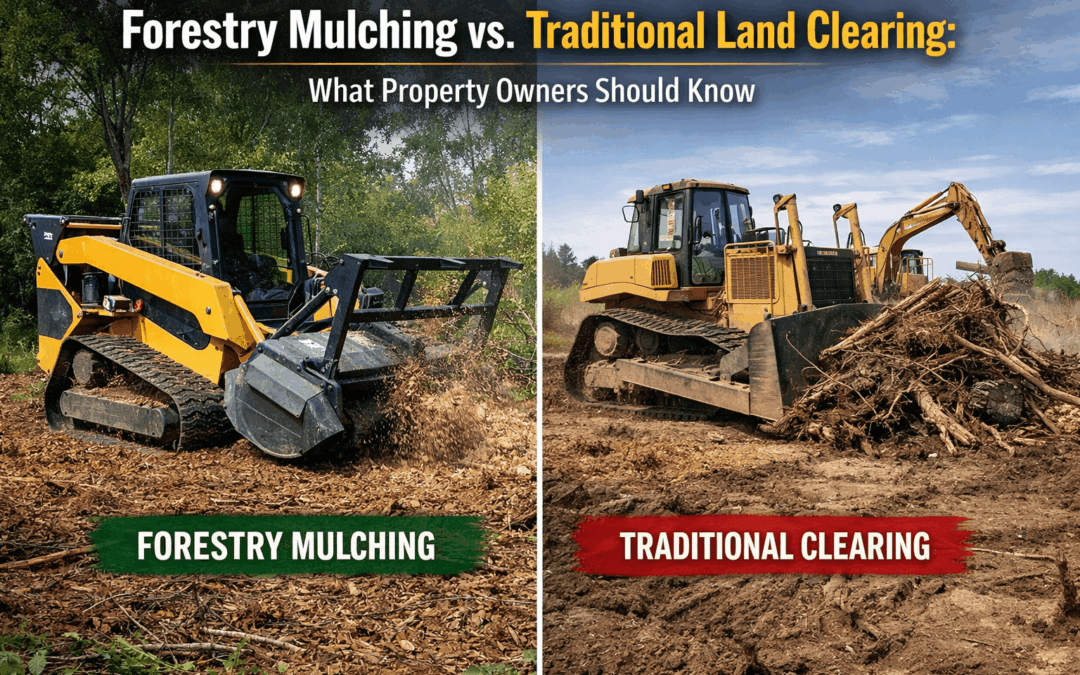
If you’ve got an overgrown property, fence line, or wooded area that’s gotten out of hand, you’ve probably started Googling ways to clear it. That’s when two options usually come up: forestry mulching and traditional land clearing.
They both remove brush and trees—but they work very differently. The right choice depends on your property, your goals, and what you want the land to look like after the job is done. As a contractor, this is one of the most common conversations we have with property owners across Chicagoland and Northwest Indiana.
Here’s a clear, no‑nonsense breakdown so you can make the right call for your land.
Quick Answer (TL;DR)
- Forestry mulching is faster, cleaner, and less disruptive—ideal for homeowners, acreage owners, fence lines, trails, and invasive species removal.
- Traditional land clearing is more aggressive and costly, but necessary for construction, foundations, and major grading.
If you’re not building something immediately, forestry mulching is usually the smarter option.
| Decision factor | Forestry mulching | Traditional clearing |
|---|---|---|
| Best fit | Brush, invasive growth, trails, fence lines, and selective clearing | Foundations, major grading, and complete vegetation removal |
| Soil impact | Roots generally remain and mulch covers the surface | Root and stump removal can expose and disturb soil |
| Debris | Processed on site in most cases | Piled, burned, buried, or hauled |
| Finished ground | Mulch-covered and generally usable immediately | May require grading, stabilization, or additional cleanup |
What Is Forestry Mulching?
Forestry mulching clears vegetation using a skid steer equipped with a high-powered mulching head. Trees, brush, and invasive growth are ground up right where they stand.
There’s typically no piling, burning, or hauling. The material is processed and left on the ground as a natural mulch layer that protects the soil.
Forestry mulching is commonly used for:
- Overgrown lots and acreage
- Invasive species removal (buckthorn, honeysuckle, saplings)
- Fence line clearing
- Trail and path creation
- Wooded areas that need thinning—not stripping
The goal is to reset the land without tearing it up. If you’d like a deeper breakdown of the process, here’s exactly how forestry mulching works from start to finish.
What Is Traditional Land Clearing?
Traditional land clearing uses heavy equipment like bulldozers, excavators, chainsaws, and dump trucks. Trees are pushed over or cut down, stumps are removed, and debris is piled, burned, or hauled off-site.
This method focuses on total removal, often including roots and stumps, and usually leaves exposed soil behind.
Traditional clearing is commonly used for:
- New construction sites
- Foundations and building pads
- Major grading or elevation changes
- Agricultural conversion
- Projects requiring complete vegetation removal
It is effective, but it is usually more disruptive. If the property has mostly grass and light brush, also compare forestry mulching with bush hogging.
Forestry Mulching vs. Traditional Clearing: Side-by-Side
1. Soil Disturbance
Forestry Mulching
- Minimal ground disturbance
- Roots stay in place, reducing erosion
- Natural soil structure remains intact
Traditional Clearing
- Significant soil disruption
- Topsoil often disturbed or removed
- Higher risk of erosion and runoff
If you care about keeping your land stable and usable after clearing, this difference matters.
2. Cleanup and Hauling
Forestry Mulching
- Mulch stays on site as ground cover
- No debris piles in most cases
- No hauling fees or dump coordination
Traditional Clearing
- Trees and brush must be hauled, burned, or buried
- Added time and disposal costs
- Larger site footprint during work
For homeowners, hauling alone can double the cost of a project.
3. Timeline and Efficiency
Forestry Mulching
- Faster setup
- One machine does the clearing and cleanup
- Ideal for tight or wooded access areas
Traditional Clearing
- Slower due to multiple machines and steps
- Requires staging areas for debris
- More downtime between phases
Most residential mulching jobs are completed in 1–2 days.
4. Environmental Impact
Forestry Mulching
- Mulch layer helps retain moisture
- Organic material returns to the soil
- Less disruption to surrounding trees
Traditional Clearing
- Removes organic material entirely
- Leaves bare ground exposed
- Greater impact on nearby vegetation
Mulching isn’t “hands-off,” but it’s far less aggressive.
5. Final Appearance
Forestry Mulching
- Clean, natural look
- Mulched ground with visible terrain
- Woods look maintained—not stripped
Traditional Clearing
- Raw, construction-style finish
- Bare soil and exposed roots
- Requires follow-up grading or seeding
Most property owners want their land usable and presentable. Mulching usually checks both boxes.
Cost Differences (What Actually Affects Price)
There’s no universal price, but here’s how costs typically break down.
Forestry mulching costs are influenced by:
- Density of vegetation
- Size of material being mulched
- Access to the area
- Total acreage or linear footage
Traditional clearing adds costs for:
- Multiple machines and operators
- Labor for piling and hauling
- Disposal or burn permits
- Site restoration afterward
For most residential and acreage projects, forestry mulching delivers more value per dollar because fewer steps are involved. Every property is different, which is why we explain our forestry mulching site visit and estimate process before any numbers are discussed.
When Traditional Land Clearing Makes Sense
Forestry mulching isn’t the answer to everything. Traditional clearing may be the better option if:
- You’re preparing for a foundation or building pad
- Stumps and roots must be fully removed
- Major grading is planned
- Utilities or septic systems require deep excavation
In these cases, aggressive clearing is sometimes necessary.
When Forestry Mulching Is the Better Fit
Forestry mulching is usually the better choice if:
- You want to reclaim overgrown land
- You’re clearing brush, not building structures
- You want minimal damage to the property
- You want faster results with less mess
- You don’t want to deal with hauling or burning
That’s why it’s become the go-to method for homeowners and acreage owners across Chicagoland and Northwest Indiana. You can learn more about our forestry mulching services in Chicagoland and Northwest Indiana and the types of properties we typically clear.
What Most Homeowners Get Wrong
The biggest misconception is thinking forestry mulching is “just chopping stuff up.” In reality, it’s a controlled, professional land-clearing method designed to balance efficiency with preservation.
Another mistake is assuming traditional clearing is always “more thorough.” In many residential cases, it’s simply more disruptive than necessary.
The right approach depends on what you want your land to look like after the job is done.
A Contractor’s Perspective
At GrindForce Land Services, we specialize in forestry mulching because it solves most real‑world property problems without creating new ones.
Our skid‑steer mulching setup allows us to:
- Work efficiently in tight or wooded areas
- Clear selectively without damaging desirable trees
- Leave properties clean and usable the same day
We’re fully licensed and insured, and we focus on clear communication so you know exactly what to expect before work starts.
Not Sure Which Method Your Property Needs?
Every property is different. Some projects are perfect for forestry mulching. Others need a more aggressive approach—or a mix of both.
If you’re dealing with overgrowth and want an honest recommendation, the next step is simple.
Reach out to GrindForce Land Services for a free estimate. We’ll look at your property, explain your options in plain language, and help you choose the method that actually makes sense for your land.