
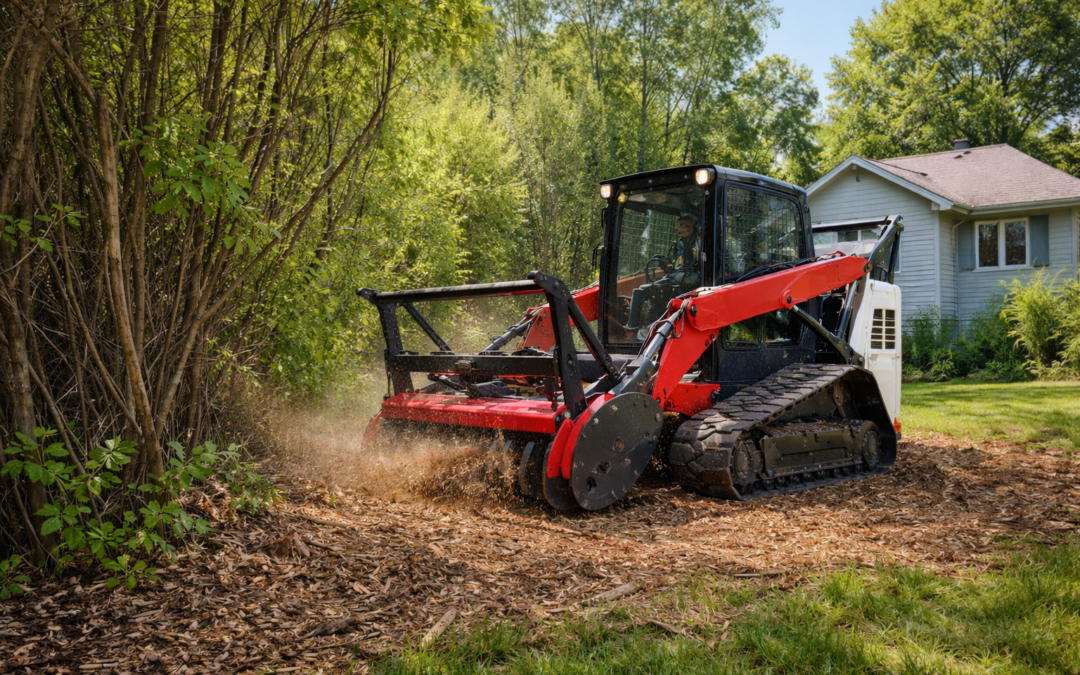
If you’ve been staring at a wall of buckthorn, honeysuckle, or tangled brush at the edge of your property, you’ve probably looked into land clearing. Standard bulldozing feels like overkill for a backyard, and hand-clearing with a chainsaw is a recipe for a sore back and a very slow summer. If you’re new to the process, this guide explains how forestry mulching works for residential properties and when it’s the right solution.
This leads most homeowners in Chicagoland and Northwest Indiana to forestry mulching. It’s fast, it’s efficient, and it looks great.
But the most common question we get when we pull the rig into a residential driveway is: “Is this machine safe for my yard?”
The short answer is that it can be safe when the property is assessed first and the work is handled by a trained, insured professional. However, "safe" covers three specific areas: your soil, your "keeper" trees, and your actual property structures. Here is what you need to know before you clear the brush.
1. Safety for Your Soil: The "Light Footprint" Advantage
Traditional land clearing often involves heavy excavators or dozers that rip stumps out of the ground. This can leave holes and exposed subsoil that may require grading, erosion control, and lawn restoration.
Forestry mulching is different. We use a high-flow mulching head attached to a skid-steer.
- Weight Distribution: These machines use wide tracks, spreading the weight out over a larger surface area. This can reduce the risk of deep rutting compared with narrower tires, although wet or soft ground still requires careful scheduling.
- The Mulch Blanket: Instead of leaving bare dirt exposed to the wind and rain, the machine leaves a layer of organic mulch behind. This acts as an immediate erosion control blanket.
- Nutrient Cycling: You aren't hauling off topsoil. You’re putting carbon back into it.
2. Protecting Your "Keeper" Trees
One of the biggest risks in residential clearing is root compaction. If a contractor isn't careful, the weight of their machinery can crush the delicate feeder roots of that 50-year-old Oak you’re trying to save.
At GrindForce, we prioritize the "drip line" of your valued trees. We don't just blindly grind everything in sight. We use the maneuverability of the skid-steer to work around the trees you want to keep, ensuring we don't nick the bark or compress the soil directly over the root system.
Pro Tip: Before your contractor arrives, tie a piece of bright flagging tape or even a simple ribbon around the trees you definitely want to keep. It creates a visual "stop sign" for the operator.
3. Dealing with Underground Utilities
Residential backyards are full of surprises: septic drain fields, sprinkler lines, and underground power.
Safety starts before the engine ever turns over. In our region—whether you're in the South Suburbs of Chicago or out in Lake County, Indiana—calling for a utility locate is a non-negotiable step.
- Septic Systems: We generally avoid driving heavy equipment directly over lateral lines or tanks.
- Gas/Electric: Mulching heads can reach a few inches below the surface to mulch a stump, so knowing exactly where those lines are is critical.
4. The "Projectile" Factor: Keeping the Neighborhood Safe
A forestry mulcher is essentially a high-speed spinning drum with carbide teeth. It’s powerful. When it hits wood, it turns it into chips, but it can also throw debris.
When we work in residential backyards, "safety" also applies to your windows, your cars, and your neighbors.
- Shielding: Professional-grade mulchers are equipped with debris curtains or deflectors to direct material downward.
- Buffer Zones: We maintain a strict "no-go" zone for people and pets while the machine is engaged.
- Operator Skill: A seasoned operator knows how to angle the head to ensure discharge stays on your property and away from glass or siding.
What to Expect After the Machine Leaves
Once the work is done, your backyard will look significantly different. You won’t see piles of burning brush or bare, scarred earth.
Instead, you’ll have a clean, walkable forest floor covered in a fresh layer of mulch. Learn why that ground cover stays on site and what to expect as it settles. Within a few months, this mulch begins to break down, suppressing the return of invasive species like buckthorn while improving the health of your remaining trees.
The Verdict
Forestry mulching can be one of the least disruptive options for residential clearing because the operator can work selectively. It allows us to remove the "junk" without destroying the ecosystem of your backyard.
If you’re ready to take back your property line or clear out that overgrown thicket, the key is choosing a team that respects your land as much as you do.
Compared with methods that remove roots and expose soil, forestry mulching usually causes less disruption—a difference we outline in our comparison of forestry mulching vs traditional land clearing.
Ready to clear the way?
If you're in Chicagoland or Northwest Indiana and want to see if forestry mulching is the right fit for your backyard, let’s talk. We provide straightforward, professional estimates and a process that keeps your property protected.
Before job day, use this property preparation checklist to mark boundaries, keeper trees, utilities, and access.
Request a free site visit from licensed and insured GrindForce Land Services.